






What Are We to Do with It?
Introduction
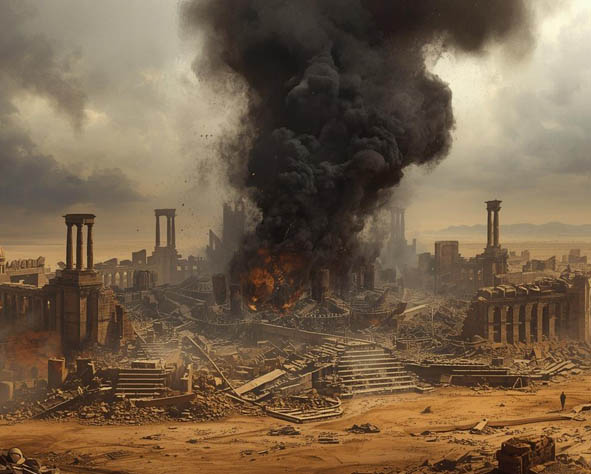
The Old Testament is disturbing. When read without preconceptions, it often appears as an endless stream of bloody and grotesque scenes. The Lord demands the destruction of His enemies and rains fire on entire cities. His dialogue with Israel consists of complaints, rebukes, and threats.
Perhaps people were crude and cruel back then. But why does God Himself seem no different?
How can we call such a wrathful, vengeful God “loving and merciful”? Can we really accept such Scripture as true revelation?
This is not a minor misunderstanding, but a serious challenge to the Christian faith.
An Ancient Problem
The Fathers of the Church already struggled to make sense of the cruelties of the Old Testament. And that was more than fifteen hundred years ago, in times we would today consider far less civilized than our own!
The gulf between the Old and New Testaments seemed so vast that some saw no way to reconcile them. For example, Marcion declared that the Lord of the Old Testament was an inferior deity, a demiurge – unconnected to Christ or even opposed to Him.
An Ancient Defense
St. Irenaeus of Lyons, St. Augustine, Origen, and others attempted to explain the Old Testament by reading it allegorically. The cruelties of the Israelites were interpreted as a call to wage relentless spiritual warfare against sin, while the hostile tribes represented various vices.
This method was popular in the Middle Ages. However, I find this line of defense weak, because it seems to imply one of two things:
1. Either the historical accounts in the Old Testament are merely allegories.
But then the key events of salvation history could also be regarded as symbolic rather than real. Scripture would dissolve into an abstract fairy tale.
2. Or the cruel events are true both historically and allegorically.
But then it would mean that God commanded the destruction of the Amalekites (or similar peoples) while also intending that this event be later interpreted symbolically. This sounds convoluted and strange.
I do not recommend using this approach in debates. An opponent will reasonably reply:
“I am not asking what this cruelty symbolizes. I am asking what actually happened.”
Our Task
We wish to profess Christian faith both prudently and lucidly, without closing our eyes to the problematic aspects of its history.
How, then, are we to justify the Old Testament and reconcile it with the New?
Beginning with the Emotions
Why does the God of the Old Testament seem “always so angry”?
The classical definition is that anger is a movement of the will against an evil that we desire to destroy and believe ourselves capable of overcoming.
But the Lord is almighty; he can annihilate any evil in an instant. Yet he tolerates it for a time in order to draw a greater good from it.
If so, then it is perfectly reasonable that God’s attitude towards fallen human history should appear to us as a constant, barely restrained wrath.
Hence the predominant tone.
Let us remember Jesus Christ. He loved mankind, yet He was also quite formidable. The saccharine image of “sweet Jesus” shatters against the Christ of the Gospels: He sternly rebuked the Pharisees and called down judgment upon them.
Christ spoke “as one having authority,” and His voice often echoes that of the Lord in the Old Testament. In this sense, the continuity between the Testaments is unmistakable.
“For our God is a consuming fire.” These words should constantly remind us of God’s transcendence and call us to render Him due reverence. Our faith and its Object are not to be treated lightly.
Important Note. We speak about “God’s anger” by way of human analogy, simplifying for the sake of understanding. In God there are no passions; there is only love toward all that exists. It is we, humans, who perceive this love differently, depending on its manifestations: as mercy when it saves, and as wrath when it purifies.
Ibi Erant Dracones
We judge the Old Testament by the standards of modern ethics, yet in those days no developed moral consciousness existed. Life was governed by a distorted natural law: the primitive and brutal rule of might. Things that are self-evident to us today, such as “you shall not kill infants,” were by no means obvious to people then.
It was a different world – in a sense, a world of grotesque monsters tearing at one another. As G. K. Chesterton writes: “The heroes of the Old Testament are not the sons of God, but the slaves of God, gigantic and terrible slaves.”
God had to work with these human beasts. Even the best of them could understand him only in their own crude, limited way, and could act solely according to what they knew.
Imagine a brilliant teacher faced with a band of feral, abandoned youths who had grown up in the wilderness. He must somehow shape them into decent and good people.
This is a task of unbearable difficulty. Do we truly have the right to condemn God for using harsh methods? Are we sure we would have done any better? Modern history sadly demonstrates that humanity lacks the wisdom and resolve to restrain or eliminate evil in time.
The Moral Anthropic Principle
Despite everything, the overall moral level of humanity has gradually risen. This suggests that God’s pedagogy has been effective.
Here lies a paradox: we are now able to abhor the cruelties of the Old Testament only because those very cruelties occurred.
Had they not taken place, we would most likely lack the very capacity to perceive them as such. We would still be living in a morally primordial state, and the same acts would strike us as normal and common.
The moral high ground on which we now stand relatively clean-footed, looking down upon the past, has been gained only through God’s laborious work in the mud of history.
Theodicy
One of the main accusations against God is that he tolerates evil and does not remove it, while we are left to suffer.
Yet when God actively confronts evil, as he does in the Old Testament, we become indignant as well. Is this not inconsistent?
When God commanded the destruction of the Amorites (or similar peoples), we should remember that they were no meek lambs. They were a violent and dangerous tribe, quick to shed blood and a constant source of misery for those around them.
For the sake of humanity’s future salvation, God had to protect his chosen people from neighbors steeped in sin and idolatry. This is also why the Lord repeatedly called the Israelites to purity: without it, the coming of Christ would have been impossible.
⚠️ His Ways Are Not Our Ways
If anyone has the right to take life, it is He who gave it. God could permit the eradication of an entire tribe because he knew with certainty that he would receive and preserve their souls.
“Do not fear those who kill the body but cannot kill the soul.”
This argument, however, is most effective for those who already trust in God’s providence and hope for eternal life. An atheist may react with hostility; he is unlikely to be comforted by the thought that an incomprehensible, omnipotent being may “kill him if it is for the best.”
Therefore, use this particular argument with great caution.
The Fulfillment of Revelation
Jesus Christ did not condemn the ancient practices outright, but perfected them. His formula is: “You have heard that it was said to the men of old… But I say to you…”
In doing so, He does not abolish the Old Testament, but fulfills and elevates it.
His New Covenant is the law of love and grace, given when humanity had gradually matured enough to receive it. It rendered obsolete the harsher practices and external prohibitions of the Old Testament. In place of the bloody sacrifices of animals, we now have the unbloody Sacrifice of Christ Himself.
As Christians, we are people of New Testament. For us, the Old Testament has meaning and value only in light of the New.

Conclusion
The Old Testament will remain a painful point in our faith, because it reflects the very pain of the history of our fallen race.
It is a difficult dialogue between the transcendent God and stubborn humanity. It is as complex as life itself, containing both wrath and mercy, severity and tenderness, and an immense love.
Isaiah 49:15: “Can a woman forget her nursing child, or show no compassion for the child of her womb? Even these may forget, yet I will not forget you.”
May the all-good God help us cast off our hardness of heart and enter into the New Creation in Christ our Lord. Amen.




1400 words — a medium-length article. About 5 minutes of reading at an average pace.
Intermediate. The article remains accessible and does not delve deeply into the complexities of theodicy, but assumes the reader has at least considered the question.
The Old Testament is God’s arduous work of educating a fallen and feral humanity.


Leave a Reply