






The Pristine, the Cultured, and the Human Vocation

Introduction
When people feel an intuitive dislike for something but struggle to articulate it, they often simply say, “It is unnatural.”
Most would unhesitatingly describe our most natural actions – eating, drinking, sleeping – as both necessary and pleasant.
Philosophy, too, often uses expressions such as “according to nature” or “the natural light of reason” in a positive sense.
However, there is also an opposite opinion: “It is natural to swing naked through the trees. Being human is about culture, not nature.”
This sounds plausible as well. It takes only one night in an unfamiliar forest without clothing or tools of any kind to dispel the myth of nature’s friendliness once and for all.
So, is what is natural good or bad?
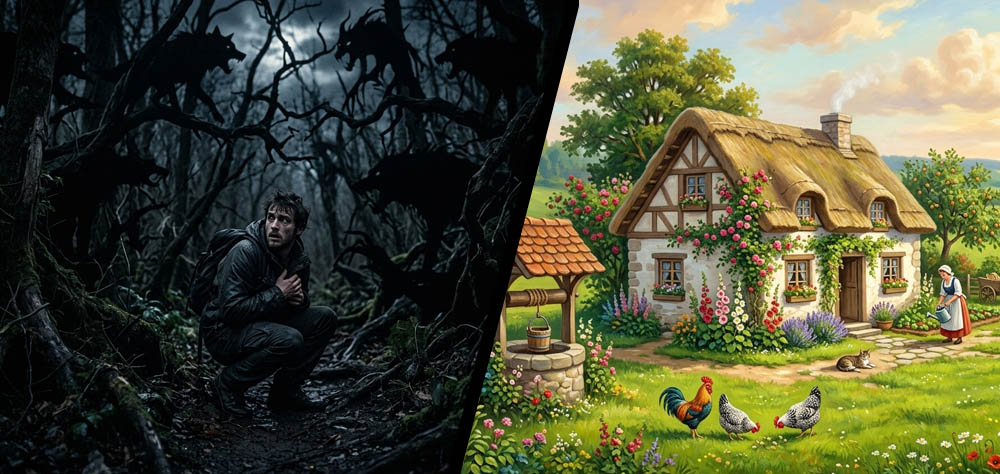
Two Faces of Nature
Definition
When a modern person hears the call to “live naturally, in harmony with nature,” a pastoral scene of downshifting comes to mind: a rural house, greenery all around, livestock, and water drawn from a well. In extreme cases, this may even mean retreating into the wilderness, living in a cave, and behaving like a feral beast.
It seems that we understand nature as the part of the world still untouched by man.
Yet in the Aristotelian-Thomistic tradition, φύσις/natura means something else. The nature of a thing is its essence, viewed as the inner source of its characteristic inclinations, actions, and properties.
Human nature, then, is not merely our instinctive side. It consists in our being rational animals.
We do have innate reflexes and biological needs, as all animals do. At the same time, everything that stems from rational mind is also natural to us: socialization, language, creativity, rituals, and art (ars/τέχνη – skillfulness, any ordering activity).
Both dimensions are integral and inseparable parts of our single nature.
Interim Conclusions
This understanding already resolves many problems. For example:
- Wearing clothes is unnatural for wild beasts, but natural for us. If a rational and skillful creature is exposed to cold, it is entirely logical for it to use its abilities to fabricate an insulating layer.
- We do not encounter houses in the wilderness, whereas caves can be found there. Yet for us, living in a house is more natural than living in a cave, because a house better serves our needs as a dwelling.
- For human beings, “natural” or “in accordance with nature” is practically equivalent to “rational” or “in accordance with reason.”
Natural and Artificial
In the classical framework, these terms are not opposites. Civilization is artificial in the sense that it is not given to us originally, yet it is natural because it flows directly from the distinctive traits of our nature. Just as a beaver builds a dam, a human builds a temple.
Two Conceptions
The modern understanding of nature as a “pristine, untouched environment” turns out to be narrower than the classical one. It reduces the entirety of nature to its most primitive aspect.
This may sound paradoxical, but in the Thomistic sense, even highways and airports belong to the nature of Creation, since they are products of rational animals.
We can roughly compare them to hives or anthills, which likewise come into existence through the natural activity of their builders.
Still, when we say, “I am going for a walk in nature,” we usually mean, “I am going to the fields, forests, or hills, where there is little human influence,” not, “I am going downtown, where civilization is most manifest.”
So, in everyday conversation, we usually have to use the term “nature” in its modern sense – otherwise, we risk being misunderstood.
The Factor of Imperfection
An objection may arise: human beings are capable of building concentration camps, harmful industries, and oppressive megacities. All of these also stem from our nature. Does this mean that even concentration camps are “natural”?
The answer is this: no.
Human nature is unique in that, unlike animal nature, it requires education in order to reach its full development. It is no coincidence that the Latin word cultura means “cultivation.”
Yet we are born into a fallen world, subject to evil. Human formation rarely reaches the desired perfection, which leads to an incomplete or distorted development of reason. As a result, the mind is capable of making false judgments and directing its powers toward false ends.
Moreover, even the most educated person is not necessarily the most virtuous. We always retain free will, which can be used for evil.
This gives rise to defective forms of civilization, which are unfortunately numerous today. They oppress us and often appear “unnatural,” even though they are our own creations and should, seemingly, be fully under our control.
We seek relief from them by retreating into nature – that is, into greenery and open spaces. The untouched begins to appear good and restorative, while the man-made comes to seem draining and harmful.
This is why statements such as “highways are natural” may even provoke anger in weary people.
However, the issue is more nuanced. Let us consider two concrete examples.
Are Highways Natural?
Yes – in the sense that they naturally arise from humanity’s desire to transport people and goods using the achievements of technology. No – in the sense that their implementation is often flawed.
It is natural for human beings to feel an aversion to loud noise: we perceive it as a sign of danger and a source of stress. Both our animal and rational dimensions agree on this.
Therefore, noisy places oppress us. The roar of engines seems to be an integral part of progress, yet in reality it runs contrary to our nature – and therefore contrary to true civilization.
The reasonable – that is, natural – use of highways should not imply their abolition altogether. They are necessary for the functioning of society.
What is needed is the mitigation of noise, the capture of harmful emissions, and their harmonious integration into the landscape.
Another Example
Cities are, in themselves, a good thing. Gathering in communities is innate to human nature. Throughout history, cities have been the foremost centers of science, art, and education. Many cities are permanently woven into the history of our species and serve as some of its key nodes.
Why, then, do many of us feel oppressed when we find ourselves in a modern metropolis of millions, surrounded by asphalt and concrete without a single blade of grass in sight? Why do we perceive such an environment as hostile, even unhealthy?
The answer is that such metropolises are often not a successful realization of the idea of the city, but rather a deformation of it.
To live and work normally, humans require open space and a balance between distance and socialization. We are made for life in communities on a human scale, not for dissolving into a crowd of millions.
The megacity may appear to be a bastion of order, straight lines, and geometry against the chaos of the primordial jungle. Yet behind its façade lies the same jungle, merely wearing a different guise. In certain aspects, it represents not the triumph of civilization, but its failure.
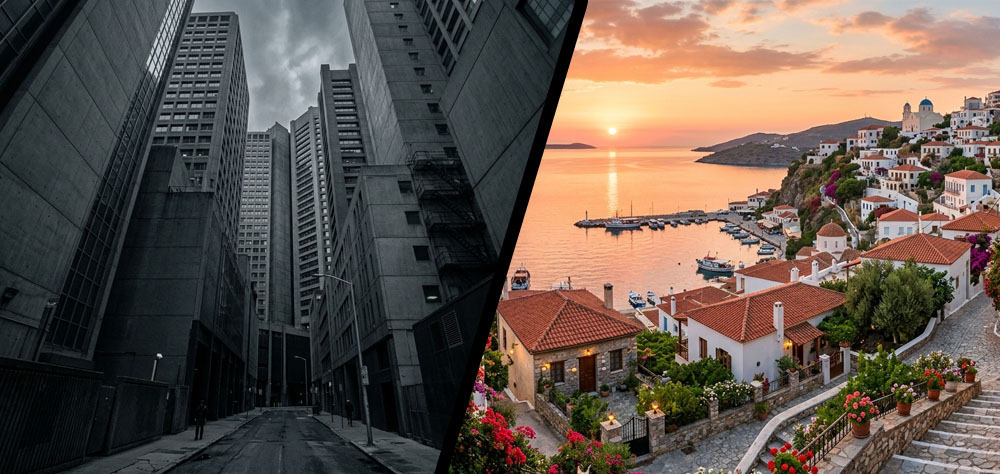
Two Faces of Civilization
Conclusion
Human beings are meant to live neither in a concrete anthill nor in a crude wilderness, but in a garden. The garden embodies the idea of cultura – cultivation itself: pristine nature ennobled through human skill and art.
This is why stories about restoring a farm, tending a garden, or renovating an old house are so popular. We long to engage in meaningful work, taming chaos and bringing forth order.
This is our original vocation on Earth. When God created the first human beings, He placed them in the Garden of Eden and entrusted its care to them. We are called neither to destroy nature nor to capitulate before it, but to cultivate, order, and elevate it.
This is true both for overgrown thickets of the external world and for the hortulus animae – the garden of one’s own soul.
The image of gardening should not be understood literally, as though every person were obliged to work the soil. Each finds their own garden, and each builds their own temple – some with leaves and branches, some with gears and wires, and some with words.
May the merciful Creator help us tend the small part of the world entrusted to each of us, so that at the end of time we may together enter the symphony of transfigured Creation. Amen.





1,400 words. A medium-length article. Approximately 5–6 minutes of reading at an average pace.
For general audience.
In the classical understanding, culture and civilization are not opposed to nature but are its continuation – provided that they are shaped in accordance with reason.
This topic is extremely broad and cannot be fully explored in a single article. The essay format inevitably simplifies certain nuances.


Leave a Reply